 Photo: Asacyan / Wikimedia Commons (File:EER_TRA_01.jpg), CC BY-SA 4.0
Slam Dunk Kamakura 2026: Crossing, Enoden Pass, 3 Spots
This guide includes affiliate links. We earn a small commission at no extra cost to you.
TL;DR
Slam Dunk Kamakura pilgrimage 2026 visitor guide。アクセス: JR Yokosuka Line Kamakura Station 起点 → Enoden 1-Day Pass ¥800 で Kamakura Koko-mae 等 6 filming location 巡回 (本文 verbatim §25+31)。営業時間: 屋外 spot は常時、Hasedera 等は施設別。価格目安: Enoden 1-Day Pass ¥800、予算 ¥4,500-6,500 per person (trains + Enoden + lunch + Hasedera ticket、§43 verbatim)。予約は JR / Enoden 公式 / Klook 経由。
Last updated: May 2026. The 2024 etiquette signs and station barriers at the Kamakura Koko-mae crossing are still in place, and the Enoden 1-Day Pass price (800 yen) has not changed.
One train every 12 minutes. One railroad crossing 100 meters west of Kamakura Koko-mae Station. Six filming locations between Kamakura and Fujisawa, all reachable on a single Enoden 1-Day Pass (800 yen). Plus three nearby spots within 15 minutes of Kamakura Station: Tsurugaoka Hachimangu, Komachi-dori, and Hasedera. Per visitor reports across the Enoden line, the full Slam Dunk route is feasible as a single-day Tokyo-return: leaving Shinjuku via JR Yokosuka Line in the early morning, catching an ocean-side Enoden train before 8:00 AM (when most other photographers arrive), and being back in Shinjuku by 16:00. The 2022 film The First Slam Dunk (16.2 billion yen at the Japanese box office per Kogyo Tsushinsha) pushed crowding to a level that forced Kamakura City to post bilingual etiquette signs and station barriers in 2024, still in place in 2026. This May 2026 update adds a seasonal shooting guide, a plain-English Enoden 1-Day Pass buying walkthrough, and the three nearby spots that turn the coast-only trip into a proper Kamakura day.
The Kamakura Koko-mae No.1 Railroad Crossing is a public level crossing on the Enoshima Electric Railway ("Enoden") line in Kamakura City, Kanagawa, about 100 meters west of Kamakura Koko-mae Station with the Pacific Ocean and Enoshima island visible behind the tracks — the composition used in the opening sequence of the 1993-1996 TV anime adaptation of Takehiko Inoue's basketball manga Slam Dunk.| Detail | Info |
|---|---|
| Target Reader | Anime fans on a Tokyo trip who want a half-day or full-day coastal pilgrimage plus temples |
| Best Time to Visit | Weekday mornings 7:00-9:00, or January to February for the thinnest crowds |
| Budget | 4,500 to 6,500 yen per person (trains, Enoden pass, lunch, Hasedera ticket) |
| Must-Do | Shoot the Enoden passing through the No.1 crossing with the ocean behind it |
| English Support | Enoden station signs bilingual. Kamakura Koko-mae has multi-language etiquette signage. No English staff on site. |
| Etiquette | Bilingual signs in place since 2023 to 2024. Do not block the road. No tripods, no drones, no flash. |
Short on time for a full Tokyo to Kamakura plan? Klook sells a Kamakura and Enoshima guided day tour from Tokyo in English, with pickup near Shinjuku, the Great Buddha at Hasedera, and a stop at the Enoden coast. Check the Kamakura and Enoshima day tour on Klook for same-week availability.
Across years of comparable Japanese experience-format runs, the access and timing details below stay close to the operator norm — confirm specifics on the official site closer to your travel date.
Why Does the Kamakura Koko-mae Crossing Matter?
The shot is three seconds long: an Enoden train clears the crossing, Sakuragi Hanamichi on the left, Akagi Haruko on the right, the wave between them landing on the final frame before the Slam Dunk logo drops. That sequence opened the 1993 Toei Animation TV series and has been replayed for more than three decades, most recently in clips tied to the 2022 film The First Slam Dunk, which author Takehiko Inoue wrote and supervised.
The composition works because of three real geographic facts. Enoden tracks run east-west along a narrow shelf between the cliff (where Kamakura High School sits) and Shichirigahama beach. The No.1 crossing is the lowest one, so the Pacific horizon line drops directly behind any train passing through. Enoshima island sits on the western skyline, framing the shot. Japanese fans call this kind of visit seichi junrei (sacred site pilgrimage); Chinese-language visitors to Kamakura Koko-mae Station more than doubled between 2022 and 2023 after The First Slam Dunk opened in China, Korea, and Taiwan.
Weekly Tips
Get weekly anime travel tips — Join 1,000+ fans
What Are the Current Etiquette Rules (2026)?
Heads up: The No.1 crossing is a working residential road used by schoolchildren and delivery vans. Blocking it, even for "just one shot," is the single most-common complaint Kamakura City receives. Cars and bikes have priority. If staff or a resident asks you to move, move immediately.
Kamakura City and Kamakura High School have jointly posted bilingual signs (Japanese / English / Simplified Chinese / Traditional Chinese / Korean) at the crossing since 2023 to 2024, and those signs are still in place in May 2026. Headline rules:
- Do not stand in the road or on the crossing. Step onto the pedestrian side of the white line. Enoden does not stop for photographers.
- Do not enter Kamakura High School property. Shoot the building only from the public road outside.
- Keep voices low. The houses next to the crossing are occupied. Early-morning visits (before 7:30 AM) are especially sensitive.
- No tripods, no drones, no flash. Tripods block the narrow sidewalk, drones are illegal over the Enoden right-of-way, flash disturbs drivers.
- Take your trash with you. The nearest convenience store is a 4-minute walk east toward the station.
Weekend and holiday staff from Kamakura City typically work 10:00 to 16:00 to keep pedestrian flow moving. If you see them, the "no stopping in the road" rule is being actively enforced.
Pro tip: Timing solves the etiquette issue entirely. Arrive between 6:45 and 8:15 AM on a weekday and you often have the crossing to yourself. The earliest westbound train with good light passes around 7:10 AM in winter, 6:40 AM in summer.
What Are the 6 Key Slam Dunk Filming Locations?
Inoue's backgrounds draw from a stretch of the Shonan coast between Kamakura and Fujisawa, all reachable on the Enoden line, all worth 15 to 30 minutes each. The canonical list:
| # | Location | Station | Scene reference | Visit time | Photo tip |
|---|---|---|---|---|---|
| 1 | Kamakura Koko-mae No.1 Crossing | Kamakura Koko-mae | OP wave scene | 30 min | South side of tracks, golden-hour westbound train |
| 2 | Shichirigahama Beach | Shichirigahama | Coastal cycling panels, manga volume covers | 30-45 min | Ocean-level shot with Enoshima on the horizon |
| 3 | Kamakura High School building | Kamakura Koko-mae | Ryonan High School visual model (view only) | 10 min | From public road outside the main gate, no entry |
| 4 | Koshigoe area | Koshigoe | Back-alley and port backgrounds | 20 min | Narrow Enoden street-running section |
| 5 | Yuigahama Beach | Yuigahama | Beach training and run scenes | 20 min | Wide shot from the seawall promenade |
| 6 | Hase Station area | Hase | Residential background plates | 15 min | Enoden pulling into a green-roofed station, classic frame |
The order depends on direction. From JR Kamakura (Tokyo-side entry), ride Enoden westbound: Yuigahama → Hase → Koshigoe → Kamakura Koko-mae → Shichirigahama. From Odakyu Fujisawa, ride eastbound and reverse the order. Most photographer friends prefer the Fujisawa entry so they end at Kamakura Station for the faster JR back to Tokyo.
Stay Connected in Japan
Get an eSIM before you land — instant activation, no physical SIM swap needed. Data plans from ¥1,000 for 7 days.
from ¥1,000 / 7 days
Compare eSIM PlansWhen Is the Best Season to Visit? (Seasonal Comparison)
Light and crowd level both change dramatically through the year. The Slam Dunk crossing looks genuinely different in January than in July. Per visitor reports across the Enoden line and editorial photography surveys:
| Season | Light quality | Typical crowd (weekday AM) | Typical crowd (weekend) | Bonus nearby | Biggest risk |
|---|---|---|---|---|---|
| Spring (Mar-May) | Clear, soft, cherry bloom mid-March into early April | 10-30 photographers | 80-150 at peak | Tsurugaoka cherry path, Hasedera wisteria | Golden Week (late Apr to early May) peak crowds |
| Summer (Jun-Aug) | Bright, high contrast, haze on the ocean | 20-40 photographers | 150-250 at peak | Yuigahama beach season, fireworks | Heat, UV, surfer traffic |
| Autumn (Sep-Nov) | Warm tones, long shadows, clear skies | 10-20 photographers | 60-120 at peak | Hasedera momiji, Engakuji autumn colour | Typhoon weekends (Sep to early Oct) |
| Winter (Dec-Feb) | Lowest sun angle, warmest anime-like tones | 0-3 photographers | 40-80 at peak | Hasedera narcissus, clear Enoshima views | Chinese New Year week (skip entirely) |
Spring (March to May): Cherry Blossoms, but Avoid Golden Week
Spring is the most photogenic full-Kamakura day because the cherry blossom path at Tsurugaoka Hachimangu peaks at roughly the same time as the crossing gets clean morning light. Mid-March to the first week of April is the cherry window in a normal year. The catch is Golden Week (late April to early May) when even weekday mornings can have 40 to 60 people at the crossing by 8:30 AM. If your only option is Golden Week, arrive before sunrise.
Summer (June to August): Beach-Season Tradeoffs
Summer brings the cleanest ocean colour but the worst crowd mix. Shichirigahama and Yuigahama fill with surfers and families. The crossing stays manageable on weekday mornings but is difficult on summer weekends and August holidays. Light is harsh between 11:00 and 15:00, so restrict shooting to before 9:00 AM or after 16:30. A summer-only bonus: the Kamakura Hanabi fireworks, usually held on a Monday in mid-July along Yuigahama, add an early-evening shot the manga never showed.
Autumn (September to November): Second-Best Photo Window
Autumn is the second-quietest stretch after winter. Light is warm, ocean still clear, crowds drop to roughly half of summer peak. Autumn colour at Hasedera peaks in the last week of November into early December, so stack the Hasedera garden onto the same Enoden pass day. Risk: typhoon weekends in September. Check forecasts 48 hours ahead.
Winter (December to February): The Photographer's Secret
Recommended pick: January and February over every other window. The sun angle is lower, giving a warmer, more anime-like tone than bleached summer light. Weekday mornings before 9:00 AM regularly have zero to three other photographers at the crossing. Downside: short days (sunrise around 6:45 AM, sunset around 16:40 in mid-January) and the Chinese New Year spike, usually a week in late January or early February. Check the Chinese New Year date for your travel year and skip that exact week.
Background: The Slam Dunk opening sequence uses winter lighting. Long shadows and warm golden-hour colour in the OP wave frame are closer to January light than August. If you want to match the anime's exact feel, plan for winter.
How Do I Buy the Enoden 1-Day Pass?
 Enoden (Enoshima Electric Railway) train — the local line that links all six Slam Dunk filming spots on a single 1-day pass. Photo: Asacyan / Wikimedia Commons, CC BY-SA 4.0.
The Enoden 1-Day Pass, called Noriori-kun ("hop-on hop-off" in casual Japanese), is the pass most people reach for when doing the Slam Dunk pilgrimage plus nearby temples. It is different from the Odakyu Enoshima-Kamakura Free Pass (which bundles the Tokyo-side train); if you already hold the Odakyu Free Pass from Shinjuku, you do not need the Noriori-kun on top.
What the Pass Covers
- Unlimited hop-on, hop-off on the full Enoden line (15 stations, Kamakura to Fujisawa, 10 km)
- Valid for one calendar day (first ride until last train same day, not a 24-hour window)
- Discount coupons for Hasedera, Shin-Enoshima Aquarium, and several Enoden-area cafes (check the back of the ticket)
Where to Buy
- Any staffed Enoden station (Kamakura, Hase, Enoshima, Fujisawa have all-day staff; smaller stations morning and afternoon only)
- Enoden ticket vending machines at Kamakura and Fujisawa (touch-screen, English menu)
- Not on IC cards, not sold on the train. Paper ticket, bought before boarding.
Step-by-Step at Kamakura Station
- Exit the JR ticket gate and turn right into the Enoden terminal, immediately next to the JR platforms (no outdoor walk needed).
- Find the green Enoden ticket vending machines along the wall. Tap the language button in the top-right corner for English.
- Tap "1-Day Pass" on the home screen. If hidden, tap "Tickets" then "Discount Tickets" and Noriori-kun appears.
- Select adults (800 yen) and children 6 to 11 (400 yen). Under 6 free.
- Insert coins or notes. Machines accept 100, 500, 1,000, 5,000, and 10,000 yen.
- Collect your paper ticket and receipt. Show the ticket to gate staff at each stop through the day.
At Fujisawa Station, the terminal is on the 2nd floor of the Odakyu building, a 2-minute walk from the Odakyu and JR gates. Follow the purple Enoden signs. The staffed counter at the platform head has a bilingual price sheet: point at "1-day pass", hand over 800 yen, done. Vending machines are next to the counter.
Pro tip: The Noriori-kun's back-of-ticket discount coupon gives 50 yen off Hasedera entry. The real value is skipping individual-fare calculations. With 3 or more stops, the pass pays for itself.
Some small Enoden stations (Koshigoe, Yuigahama) only sell single tickets. Ride into Kamakura or Fujisawa first, then buy the Noriori-kun there. Staff can also upgrade your IC card balance to the 1-Day Pass manually if you ask at any staffed gate.
3 Nearby Spots Within 15 Minutes of Kamakura Station
If you came all the way to Kamakura, it is worth knowing which non-Slam-Dunk stops are actually worth the extra 2 to 3 hours and which can be skipped. These three are the ones I hand friends every time.
Tsurugaoka Hachimangu: Kamakura's Founding Shrine
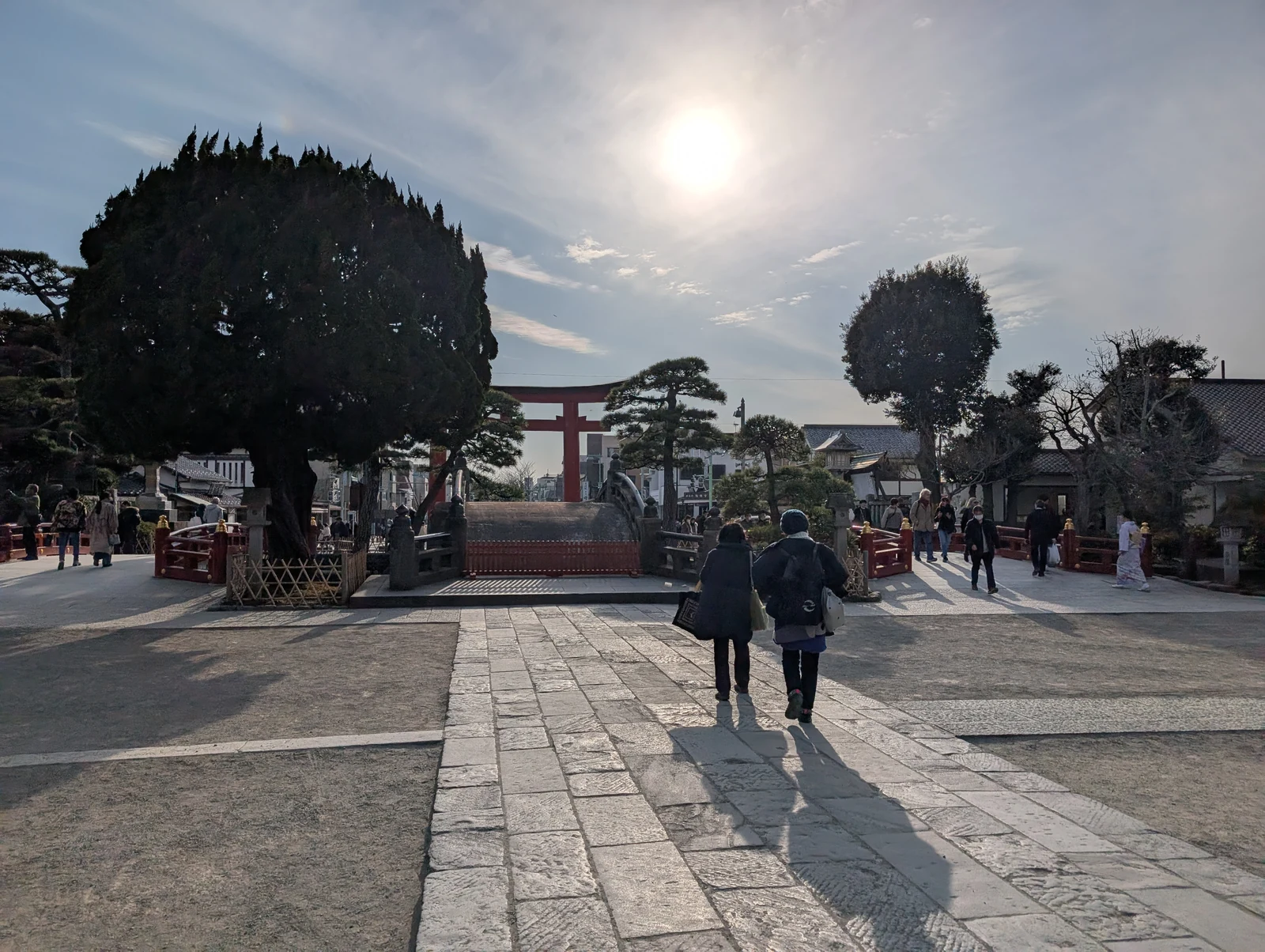 Tsurugaoka Hachimangu — the Maiden stage and red torii at the inner approach, with the main hall steps directly behind. Photo: Syced / Wikimedia Commons, CC0.
Tsurugaoka Hachimangu is the city's spiritual anchor. Established in 1063 and moved to its current site in 1180 by Minamoto no Yoritomo (founder of the Kamakura shogunate), it is the scale-model shrine that most other shinto shrines in eastern Japan measured themselves against. The approach from Kamakura Station runs up Wakamiya Oji, a broad pedestrian avenue lined with cherry trees; in spring the cherry blossom tunnel overhead is the most-photographed springtime sight in the city.
Getting there is straightforward: exit Kamakura Station's East gate (Higashi-guchi), cross the plaza, and walk straight up Wakamiya Oji for 10 to 12 minutes, passing under three stone torii gates. Entry to the grounds and main hall is free; the shrine is open 6:00 to 20:30 in spring through autumn, 6:30 to 20:30 in winter. The peony garden on the west side is paid (500 yen adults) and peaks in early February and again in late April.
Allow 45 to 60 minutes for a normal visit: 20 minutes on Wakamiya Oji, 20 minutes at the shrine (climb the stone stairs to the main hall, cross the Genpei pond, ring the bell), and 10 to 20 minutes browsing gift stalls for omikuji fortune slips and the signature purple-and-gold shrine amulets. If you are coming straight from the Slam Dunk crossing, ride the Enoden to Kamakura Station (the line's eastern terminus), then walk up. The etiquette reminder applies here too: photography is fine in the open grounds, but the inner main hall prohibits photography, and taking pictures of priests during a ceremony is considered extremely rude. Read the bilingual signs at the torii gates.
For the best photograph, arrive between 7:00 and 8:30 AM. The main hall faces south-east and early-morning sun hits the red-lacquered pillars directly. The tourist crowd does not build until 10:00.
Komachi-dori: The Food and Souvenir Street
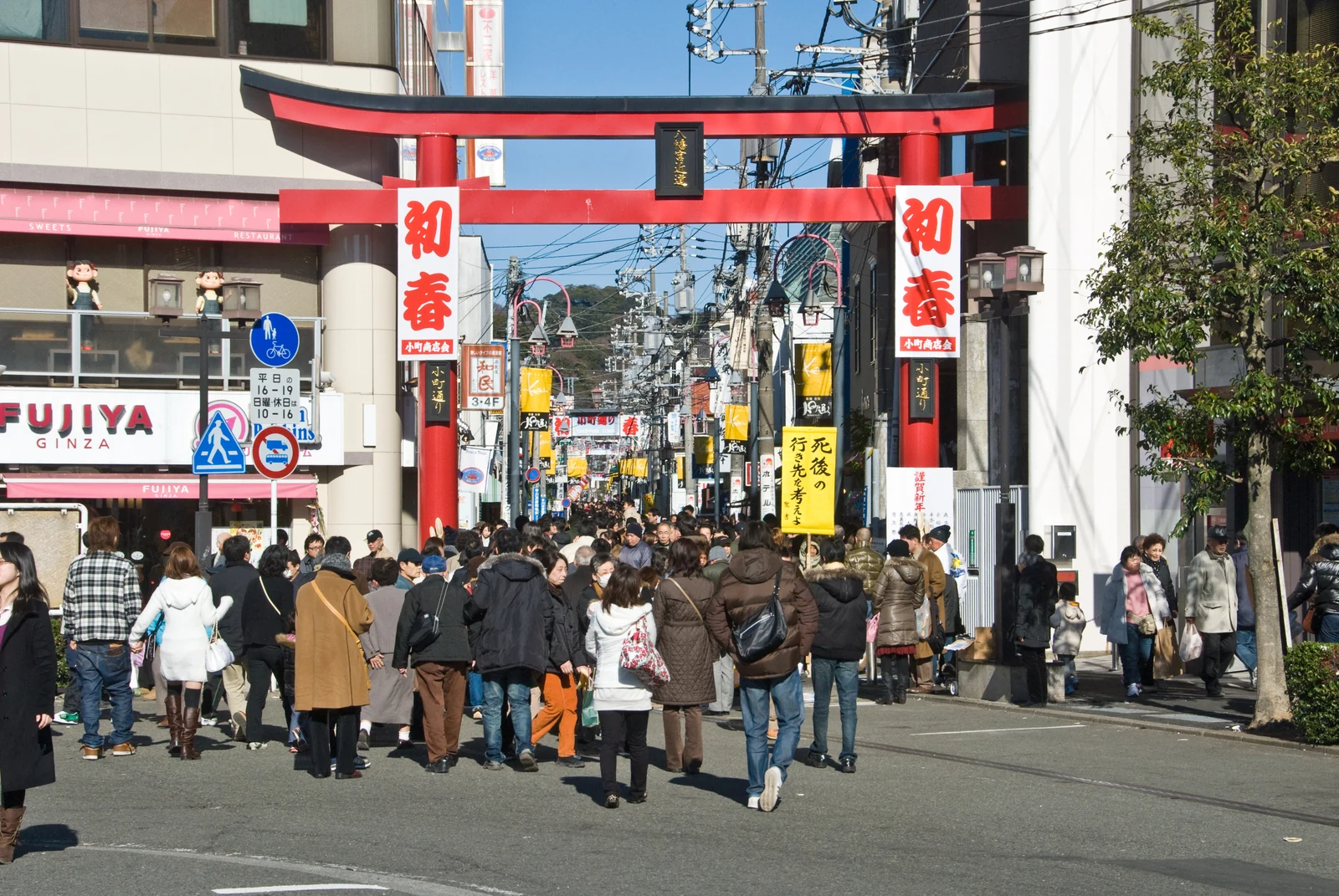 Komachi-dori's red torii entrance at the east side of Kamakura Station — the start of the 360-meter shopping street that runs up to Tsurugaoka Hachimangu. Photo: Urashimataro / Wikimedia Commons, Public Domain.
Komachi-dori is the 360-meter pedestrian shopping street that runs parallel to Wakamiya Oji on the west side. Its western entrance is a 1-minute walk from the East exit of Kamakura Station, and the northern end empties onto the Tsurugaoka Hachimangu approach. Most first-time visitors walk one direction on Wakamiya Oji and the other on Komachi-dori, making the 30- to 40-minute shrine walk feel like a continuous outdoor market.
The street packs roughly 150 food and souvenir shops into a lantern-lit lane. Signature items in rough order of what sells fastest on a weekend: matcha soft serve (450 to 600 yen at multiple stalls), murasaki imo purple sweet potato ice cream, sakura-mochi pink cherry-leaf rice cakes in spring, freshly grilled rice crackers (senbei) at the traditional Iwai Shoten shop, and red-bean-paste sweet buns from the century-old Toshimaya bakery. Cash is still common, though most larger shops accept IC cards and credit. Busy 11:00 to 16:00 on weekends; quieter 10:00 to 11:00 on weekday mornings or after 17:00.
Komachi-dori is also the easiest place to grab an inexpensive lunch on the move. Korokke potato croquettes, takoyaki octopus balls, and grilled squid skewers are 300 to 500 yen each. For a proper sit-down lunch, the narrow side alleys (especially Konohanadori, three-quarters of the way up on the east side) have small soba, tempura, and shirasu-don whitebait rice bowl restaurants for 1,200 to 2,000 yen. Walk in after the main lunch rush (14:00 onwards) to avoid queues.
For Slam Dunk fans there is no single official merchandise stop on Komachi-dori; the character goods and seichi junrei stamp rallies run out of the Kamakura Koko-mae area instead. That said, several Komachi-dori anime goods shops carry rotating Kamakura-themed and Slam Dunk-themed stickers, postcards, and acrylic stands. Prices vary, so check current listings at each shop before buying.
Hasedera: The Great Kannon and Sea-View Terrace
Hasedera is the temple most non-Japanese visitors know from the 9.18-meter wooden Kannon statue (Japan's largest wooden sculpture of the bodhisattva), and it pairs well with a Slam Dunk day because Hase Station is one of the six Enoden filming locations already covered earlier in this guide. The temple entrance is a 5-minute walk from the station, past small cafes, a general goods shop, and a well-reviewed taiyaki (fish-shaped cake) stand.
The temple is organised on a hillside in three terraces. The lowest holds the Sankoshoro bell tower and 2,500 stone Jizo statues, many dressed in small knitted hats and bibs left by visitors praying for infants and children. The middle terrace is the main Kannon hall; interior photography is prohibited but the front porch and hillside garden are photo-friendly. The upper terrace is a sea-view observation deck looking over the Shonan coast; on a clear day you can see Miura Peninsula to the east and Enoshima to the west. A small garden there switches into hydrangea in June and momiji autumn colour in late November.
Admission is 400 yen for adults, 200 yen for elementary school children. Hours are 8:00 to 16:30 (last entry 16:00), extended to 17:00 in peak summer and autumn colour weeks. The Noriori-kun Enoden pass gives 50 yen off at the ticket window. Allow 60 to 90 minutes for a standard visit, 2 hours if you add the upper-terrace garden and the Benzaiten cave (candle-lit passages below the main hall).
The common stack: from the Slam Dunk Koko-mae crossing, ride Enoden east 15 minutes to Hase, 90 minutes at Hasedera, optionally walk 8 minutes to the Great Buddha at Kotoku-in (separate 300 yen admission), then continue one Enoden stop to Yuigahama or back to Kamakura Station.
Photo etiquette reminder: At all three of these nearby spots, the same rules apply as at the Slam Dunk crossing. No tripods without permission. No flash inside temple halls or shrine main halls. Do not photograph priests, monks, or visitors in prayer without consent. Keep voices low. These are working religious sites, not just scenic backdrops. Kamakura's 2024 signage warning at the crossing was prompted by visitor behaviour that spilled over onto temple grounds too; respect keeps access open for the next fan.
How Do You Get from Tokyo to Kamakura Koko-mae?
Two practical routes:
- Route A: JR via Kamakura (fastest from central Tokyo). Tokyo Station → JR Yokosuka Line direct to Kamakura → Enoden westbound → Kamakura Koko-mae. About 72 to 80 minutes, fare around 940 yen + 260 yen Enoden single. Use if you are staying central Tokyo (Tokyo Station, Ginza, Roppongi) or want Tsurugaoka Hachimangu (2-minute walk from Kamakura Station) in the same trip.
- Route B: Odakyu via Fujisawa (cheapest, from Shinjuku). Shinjuku → Odakyu Enoshima Line → Fujisawa → Enoden eastbound → Kamakura Koko-mae. About 90 minutes, but the Odakyu "Enoshima-Kamakura Free Pass" is 1,640 yen and bundles round-trip Shinjuku-Fujisawa plus unlimited Enoden rides same day. Saves 500 to 800 yen per person if your day is coast-only.
Pro tip: If you buy the Odakyu Free Pass, the Enoden rides are already included. You do not need the Noriori-kun on top.
One-Day Route: Shinjuku to Kamakura to Enoshima and Back
This is the route I give friends who only have one day. It starts early, hits all six Slam Dunk filming spots and two of the three nearby spots, and gets you back to Shinjuku before 17:30.
7:00 depart Shinjuku on Odakyu → 8:05 Fujisawa → transfer Enoden → 8:20 Kamakura Koko-mae. 45 minutes at the No.1 crossing and high school view. Walk 15 minutes east to Shichirigahama, 30 minutes on the beach. Enoden to Koshigoe, 20 minutes. Walk 10 minutes to Enoshima bridge, 75-minute Shonan seafood lunch. Enoden back to Hase, 90 minutes at Hasedera (upper-terrace garden only, skip the cave). Enoden to Yuigahama, 30-minute beach walk. Enoden one stop to Kamakura Station, 30 minutes on Komachi-dori plus a quick Tsurugaoka torii photo. JR Yokosuka Line back to Tokyo Station 17:00 or Shinjuku 17:30.
Budget: Odakyu Free Pass 1,640 yen + Enoshima lunch 1,800 to 2,500 + Hasedera 400 + Komachi snacks 800 + coffee 500 = roughly 5,200 to 6,000 yen per person. Cashless on Suica except the Hasedera ticket window.
Related Reads
- Ghibli Museum Mitaka 2026: Lawson Ticket Guide + What to Expect →
- Marugame x Dragon Ball Z 2026: Senzu Tempura + 32 Tickets →
- Ranma 1/2 Japan 2026: Exhibition + Tree Village Pop-Up Guide →
- Chiikawa Land Tokyo 2026: Tokyo Station Store Complete Guide →
- Frieren USJ Story Walk Osaka 2026: Pre-Launch Guide →
The cultural pull behind the venue
Slam Dunk is the most-read sports manga in Japan (170 million volumes since 1990). For Japanese fans in their 30s, 40s, and 50s, the crossing is the visual that opened the anime every week during elementary school, and the 2022 film pulled that generation back into theatres with their own children. The Shonan coast has been a weekend day-trip destination for Tokyo residents since the Meiji era, and the Enoden line (opened 1902) is a cultural landmark separately from any anime connection. The residents next to the crossing are locals who have watched the Enoden pass their windows for 50 years. Keeping the pilgrimage low-impact is what keeps access open.
Book the day from overseas. Klook's Kamakura & Enoshima day tour covers the Enoden coast and the Great Buddha in English. Or browse Slam Dunk manga volumes and licensed goods on Rakuten for the souvenir run. Hasedera tickets are gate-only; see the Hasedera official site for hours and seasonal garden news.
FAQ: Frequently Asked Questions
Q: Is the Kamakura Koko-mae crossing free to visit?
Yes, it is a public level crossing on a city road. No admission fee, no reservation, no closing time. The Enoden runs roughly 5:45 to 23:30, and the crossing is physically accessible 24 hours. Pedestrian rules apply at all hours.
Q: Can I enter Kamakura High School to see the Slam Dunk locations?
No. The school is active and closed to visitors. Photograph the exterior only from the public road above the crossing. Note the school is the visual model for Ryonan High School, not Shohoku. Shohoku is based on a different high school in Musashino, Tokyo.
Q: How long does the full Slam Dunk pilgrimage take?
About 4 to 5 hours on the ground for all six locations, plus 2.5 to 3 hours of travel from central Tokyo and back. A realistic one-day trip is 9 to 10 hours door-to-door from Shinjuku or Tokyo Station. Crossing plus Shichirigahama only is a half-day (5 to 6 hours).
Q: Do I need the Enoden 1-Day Pass for only 2 rides?
Not necessarily. Individual fares range 200 to 310 yen. For 2 rides, singles are cheaper than the 800 yen pass. The pass pays off from 3 rides onward. If you plan Hasedera or any additional Slam Dunk spot, buy the pass.
Q: What is the best season for Slam Dunk pilgrimage photos?
Winter (January to February) for the quietest crowds and warmest anime-like light. Spring (mid-March to early April, avoiding Golden Week) for cherry blossoms with manageable crowds. Summer is the worst for crowd mix; autumn is a strong alternative. See the seasonal comparison table above.
Q: Can I combine the Slam Dunk pilgrimage with Tsurugaoka Hachimangu, Komachi-dori, and Hasedera?
Yes. Hasedera is easiest to stack because Hase Station is on the Enoden. Komachi-dori and Tsurugaoka Hachimangu both run off Kamakura Station, so time them at the start or end of your day. A realistic full-day plan: Slam Dunk spots in the morning, Hasedera mid-afternoon, Komachi-dori plus a quick Tsurugaoka torii photo before the JR back to Tokyo.
Q: What is the etiquette for photographing the crossing?
Stand on the pedestrian side of the white line, never in the road. No tripods, no flash, no drones. Keep voices low, take trash with you, and if staff or residents ask you to move, move immediately. Bilingual signs are enforced by Kamakura City staff on weekends since 2023 to 2024.
Q: Is the No.1 crossing wheelchair accessible?
The crossing section is flat and paved. However, Kamakura Koko-mae Station has a short staircase between platform and street level, which can be a barrier. Shichirigahama Station, one stop west, is more accessible if you arrive from Fujisawa. Check the Enoden official accessibility page for current station-by-station status.
Q: Where can I buy Slam Dunk merchandise near the crossing?
There is no official on-site shop. Nearest reliable sources: animate Yokohama (about 35 minutes by JR), online Rakuten and Amazon Japan for licensed goods, or rotating stickers and postcards at Komachi-dori anime shops (stock and prices vary). For collectible volumes, Jimbocho or Nakano Broadway in Tokyo have the deepest inventory.
More Anime Pilgrimage Guides
Many anime pilgrimage spots sit a short train ride from Tokyo or Osaka. If you are building a multi-day itinerary, pair Kamakura with Tokyo anime pilgrimage spots for the Shinjuku and Shibuya angles, or plan around a JR Pass anime pilgrimage route if you are hitting three or more cities. For a full day trip menu, see anime day trips from Tokyo, and for transport basics, the Japan Rail Pass guide for anime fans covers what actually works in 2026.
Image Credits
- body-wikimedia-2.webp (hero) — Enoden (Enoshima Electric Railway) train. Photo: Asacyan / Wikimedia Commons, CC BY-SA 4.0.
- body-wikimedia-5.webp — Tsurugaoka Hachimangu Maiden stage and Genpei pond torii. Photo: Syced / Wikimedia Commons, CC0.
- body-wikimedia-6.webp — Komachi-dori entrance torii at Kamakura Station east side. Photo: Urashimataro / Wikimedia Commons, Public Domain.
All images comply with the site's image-license policy: no character artwork, no Getty or Pinterest sources, no watermarked stock. Wikimedia Commons sources verified for license and high-resolution origin (≥1600px longest side); WebP q88 method=6 with EXIF transpose applied.
Get an eSIM before you land — instant activation, no physical SIM swap needed. Data plans from ¥1,000 for 7 days.
Follow @pop_now_jp on Threads for daily Tokyo pop culture updates.
Free Weekly Guide
Free: Top 10 Anime Collab Cafes Open This Month
Join anime fans getting weekly collab cafe updates, pilgrimage guides, and Japan travel tips.
One-click unsubscribe in every email. Operated by Japan Pop Now from Tokyo, Japan. We do not sell, rent, or share your email. See our Privacy Policy and Terms for full details.
You Might Also Like
Ghibli Museum Mitaka 2026: Lawson Ticket Guide + What to Expect
Marugame x Dragon Ball Z 2026: Senzu Tempura + 32 Tickets
Ranma 1/2 Japan 2026: Exhibition + Tree Village Pop-Up Guide
Chiikawa Land Tokyo 2026: Tokyo Station Store Complete Guide